
The Voortrekker Monument
The Voortrekker Monument, symbol of Afrikaner Freedom and Political Ideal
The Voortrekker Monument stands just outside Pretoria on the summit of a hill known as Monument Koppie. It was built in
honour of the Voortrekkers. Gerard Moerdijk was appointed as architect. The idea to honour the Voortrekkers with a monument
was first voiced by General Piet Joubert on 16 December 1895.
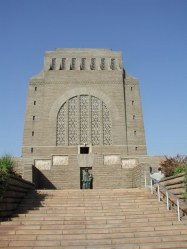
Images. 1) The Voortrekker Monument outside Pretoria was completed in 1949. Inside is a marble frieze containing
27 panels commemorating events of the Great Trek in which settlers of Dutch origin emigrated from Cape Colony to the
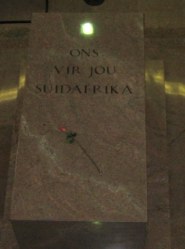
Transvaal between 1835 and 1854. At the centre of the monument is the cenotaph which bears the inscription "We for
thee, South Africa". An opening in the dome atop the monument is positioned so that every year at noon on the 16th of
December a beam of sunlight illuminates the cenotaph. Prior to the 1994 elections which brought Nelson Mandela to
power, December 16th was celebrated as the "Day of the Vow", commemorating the massacre of the Zulus in the Battle
of Blood River; it remains a holiday but is now called "Reconciliation Day". Surrounding the monument is a circular wall
with reliefs representing the wagons of voortrekkers pulled into a circle.
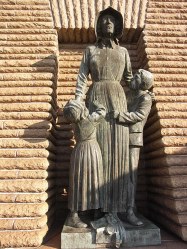
2) Woman and Children by Anton van Wouw at the base of the Voortrekker Monument in Pretoria.
3) The Cenotaph.
Voortrekker, name given to Afrikaners (or Boers) who migrated north from the British Cape Colony (modern southwestern .
South Africa) during what became known as the Great Trek (1835-1843). The word Voortrekker means "pioneer" in the
Afrikaans language. The migration of the Voortrekkers marked the birth of Afrikaner nationalism and the determination of
Afrikaner, settlers of Dutch and French Huguenot descent, to shake off British control. In the course of the Great Trek, the Voortrekkers
fought the British, Zulu and other Bantu-speaking peoples for their land. The Voortrekkers then established
the Afrikaner republics of the Orange Free State and the South African Republic (in the Transvaal region).
Leaders of the Voortrekkers, such as Hendrik Potgieter, Andries Pretorius, Pieter Retief, and Dirk Uys, are among the
most revered names in Afrikaner history. The Voortrekker Monument in Pretoria, inaugurated in 1949, was built as a
symbol of Afrikaner nationalism, and as a celebration of the Great Trek.
Six motifs determined the architect's design:
1) A religious motif based on Genesis 12. In particular verses 1 and 7.
2) An Egyptian motif, derived from the symmetry, stability and infinite durability of the pyramid through the ages.
3) An Africa motif. To incorparate the vastness of Africa, large granite blocks were used at the bottom of the construction.
Other Africa elements include the buffalo head, symbol of protection, above the main entrance; the blue wildebeest, symbol
of Dingane's impis who murdered Piet Retief; and the assegais on the entrance gates to the Monument.
4) The Zimbabwe ruins motif. It represents the timelessness of Africa. The zig-zag patterns, symbolical of water and fertility,
on the top edge of the Monument derive from this structure.
5) The European motif. Reference was made to the monumental tradition of Europe, in particular the Völkerschlachtdenkmal
in Leipzig and the Hotel des Invalides in Paris. The interior frieze which depicts scenes from the Trek is in the style of the
Renaissance Italian sculptors Verrocchio and Donatello.
6) The Voortrekker motif.....the main motif. It is represented by the 64 wagon laager, symbolic of the Battle of Blood River,
which surrounds the Monument. An important place was given to the Voortrekker woman: a statue of a mother with two
children stands at the entrance. Statues on the four corners depict three Trek leaders - Piet Retief, Andries Pretorius,
Hendrik Potgieter and the "Unknown Voortrekker".
Construction started on the 13th of July 1937. The monument was inaugurated on 16 December 1949 and stands 40 metres
high with a base of 40 m by 40 m.
An amphitheatre which seats 20 000 was built to the north west of the monument in 1949. The focul point on the lower level
of the monument is the cenotaph (symbolical grave of Piet Retief) engraved with the words "Ons vir jou Suid Afrika" ( We for
thee, South Africa). A cupola (dome) admits sunlight and a ray illuminates this inscription on 16 December at exactly 12 o'clock.
The 16th of December was the Day of the Vow. On that day in the year 1838, on the banks of the Ncome river 470 Voortrekkers
took a public vow (or covenant) together before the battle between them and about 10 000. In return for God's help in
obtaining victory, they promised to build a church. Participants also vowed that they and their descendants would keep the
day as a holy Sabbath.
It was a decisive Voortrekker victory, casualties amounted to three thousand Zulu deaths and three wounded Voortrekkers.
A monument was erected on the site of the battle in 1947, consisting of an ox wagon executed in granite by the sculptor
Coert Steynberg. In 1971 a laager of 64 ox wagons cast in bronze was erected, and unveiled on 16 December 1998.